

One of the questions we’re often asked by parents is whether it’s a good idea for brothers or sisters to learn the same instrument. Will they encourage each other, or will it simply lead to constant comparisons?
The short answer is that it can be one of the best decisions a family makes.
At NZ Modern School of Music, we’ve taught many families where two, three and sometimes even four siblings have learnt music with us. While every family is different, we’ve found that sibling rivalry is usually far less about the instrument they choose and much more about the environment that parents and teachers create.
In fact, some of our most memorable musical moments have involved siblings performing together, encouraging each other and celebrating each other’s achievements.
Why do siblings compare themselves?
Children naturally compare themselves with the people around them, particularly their brothers and sisters. They grow up in the same house, often attend the same school and share many of the same experiences. If they’re also learning the same instrument, it’s only natural that comparisons will happen from time to time.
One child might learn a piece more quickly, while the other is more confident performing in front of an audience. One may enjoy practising every day, while the other needs a little more encouragement.
The important thing to remember is that these differences are completely normal.
Every child develops at their own pace. Some have a natural ear for music, while others develop their confidence more gradually. Neither approach is better – they’re simply different musical journeys.
The challenge isn’t stopping comparisons altogether. It’s helping children understand that music isn’t a race.
The advantages often outweigh the challenges
Parents sometimes focus on the possibility of rivalry, but we’ve found there are many more positives than negatives when siblings learn the same instrument.
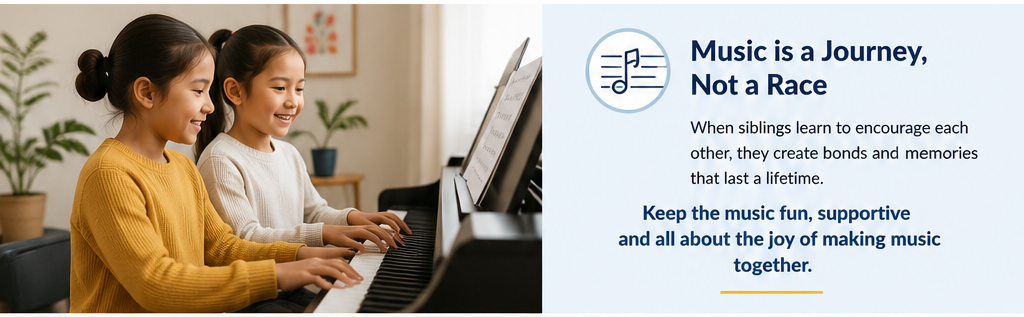
Music gives children something they can genuinely share. We’ve seen older brothers helping younger sisters count rhythms, sisters practising duets together before concerts and siblings quietly encouraging each other before practical exams.
Those shared experiences often become some of the highlights of learning music.
There are practical benefits too. Families can usually share an instrument at home, music books and lesson times, making learning more convenient and affordable.
Perhaps most importantly, music becomes something the whole family talks about and enjoys together.
What happens if one child progresses more quickly?
This is probably the biggest concern parents have.
It’s very common for one sibling to appear more musical than another, but that doesn’t necessarily mean they’ll always stay ahead.
Children mature at different rates. Some develop excellent coordination early, while others flourish as they become older. We’ve taught many students who struggled initially before suddenly making enormous progress a few years later.
Success in music isn’t determined by who learns fastest.
Consistency, enthusiasm and regular practice almost always have a greater impact over the long term than natural talent alone.
Helping children understand this lesson is valuable not only in music but in many other aspects of life.
Should siblings have the same teacher?
There isn’t a single right answer.
Some siblings thrive with the same teacher. The teacher gets to know the family, understands each child’s personality and can often schedule lessons conveniently.
In other situations, different teachers can work better. Occasionally a child enjoys having something that’s uniquely their own, particularly if they’re often compared with an older brother or sister.
At NZ Modern School of Music, our teachers always look at the individual child rather than applying the same approach to every family.
The goal isn’t simply learning an instrument – it’s creating a positive musical experience.
How parents can help
Parents play the biggest role in shaping how siblings experience music lessons.
Here are a few simple ways to keep music positive:
- Celebrate individual progress. Rather than comparing siblings, focus on how much each child has improved since last week or last term.
- Praise effort as much as achievement. Practice habits, persistence and resilience deserve just as much recognition as exam marks or performances.
- Avoid accidental comparisons. Even well-intentioned comments such as “Your brother learnt that piece much faster” can make children feel they’re competing rather than learning.
- Encourage music together. Playing duets, listening to each other practise or attending concerts together reminds children that music can be something they share.
- Allow different musical interests. One child may enjoy classical piano while another prefers movie themes or contemporary songs. Individual interests help children develop their own musical identity.
How teachers can help
Experienced teachers understand that siblings are individuals first and siblings second.
Some of the ways teachers can support families include:
- Tailoring lessons to each child. Different personalities and learning styles deserve different teaching approaches.
- Choosing suitable repertoire. Siblings don’t always need to learn exactly the same pieces at the same time.
- Providing individual feedback. Children should understand that their progress is measured against their own goals rather than someone else’s.
- Creating opportunities to collaborate. Duets and ensemble performances can turn music into a shared achievement rather than a competition.
When should parents be concerned?
A little healthy competition isn’t necessarily a bad thing.
In fact, many children become motivated after seeing what their sibling can achieve.
However, it’s worth paying closer attention if music starts becoming a source of stress rather than enjoyment.
Some signs include:
- A child refusing to practise because they “can’t be as good as” their sibling.
- Regular arguments whenever music is mentioned.
- A noticeable loss of confidence.
- One child constantly feeling overshadowed.
If this happens, don’t panic.
Sometimes a few simple changes are all that’s needed. Choosing different repertoire, staggering lesson times or giving each child separate performance opportunities can quickly restore confidence.
Most importantly, keep reminding children that music is about personal growth, creativity and enjoyment—not about being better than someone else.
Looking beyond music
One of the unexpected benefits we’ve noticed over the years is that learning music together teaches children skills that extend well beyond the instrument.
They learn to encourage others, celebrate someone else’s success, work through frustration and appreciate that everyone improves at a different pace.
Those are life skills that stay with them long after the music lessons finish.
Final thoughts
Sibling rivalry is a natural part of family life, whether children play sport, learn music or simply grow up together.
Fortunately, music also provides countless opportunities for siblings to support one another, celebrate together and create lasting memories.
At NZ Modern School of Music, we’ve seen many families discover that learning the same instrument doesn’t create rivalry at all. Instead, it creates conversations around the dinner table, practice sessions that turn into family performances and brothers and sisters who quietly inspire one another to keep improving.
Every child deserves to feel proud of their own musical journey.
When parents and teachers focus on encouragement rather than comparison, siblings often discover that music isn’t something to compete over—it’s something they can enjoy together for many years to come.